
Automatic Gratuity: Legal Rules, What It Is & Do You Tip Extra?
Quick Answer
Automatic gratuity is a pre-determined service charge (usually 18% or 20%) added directly to the bill for parties of 6 or more. Under IRS regulations, automatic gratuity is legally classified as service charge revenue rather than a discretionary tip, and you are not obligated to tip any additional money.
- ✓Most restaurants apply an 18% to 20% automatic gratuity for dining parties of 6, 8, or more guests.
- ✓Under IRS ruling (Rev. Rul. 2012-18), mandatory gratuity is treated as restaurant service wages subject to payroll tax withholding.
- ✓Always inspect your itemized check before writing an extra tip so you do not accidentally double-tip.
- ✓You are never obligated to add extra tip on top of auto-gratuity, though an extra 2% to 5% is appreciated for phenomenal service.
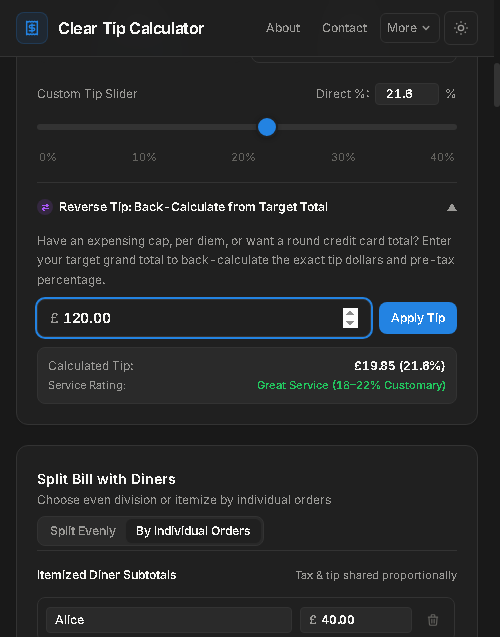
Clear Tip Calculator includes reverse calculation capabilities, helping large dinner parties determine the exact pre-tax subtotal and tip percentage from an all-inclusive grand total.
- Enter your desired target budget or the final grand total on your group receipt.
- Let the calculator deduce the embedded tip percentage and base food charges.
- Verify whether an 18% or 20% automatic service charge was applied fairly.
Why Restaurants Enforce Automatic Gratuity on Large Tables
Large dining parties require substantial dedicated resources. When a group of 8 to 15 diners sits down, a server often dedicates their entire shift to that single table, turning away other tables. If a large group splits a check awkwardly or fails to tip adequately, the server’s entire shift earnings can be compromised.
To protect server compensation, restaurants establish automatic gratuity policies—most commonly 18% or 20% on groups of 6 or more. By law, this policy must be clearly disclosed on the menu or posted visibly prior to ordering.
When organizing a group dinner, you can simplify the math by using our Clear Tip Group Bill Splitter or reviewing our advice in How to Split Large Group Dinner Bills Without Math Drama.
The IRS Rule & The Accidental "Double-Tip" Trap
In 2014, the Internal Revenue Service issued strict enforcement regarding automatic gratuity (IRS Revenue Ruling 2012-18). Under this rule, any mandatory percentage added to a check is categorized as a service charge rather than a tip.
This led to a common confusion on modern customer receipts: the bill includes an "Auto-Gratuity (18%)" line item, but the bottom of the credit card slip still features a blank "Additional Tip: _____" line. Unwary diners frequently do not notice the auto-gratuity line and mistakenly write down another 20%, unintentionally tipping nearly 40%!
Always review the line items above the total before signing your merchant slip. If you see an 18% or 20% auto-gratuity line, you can simply draw a line through the additional tip section or write "$0.00."
Is Automatic Gratuity Legally Mandatory for Diners?
A frequent debate arises over whether a diner can legally refuse to pay automatic gratuity. If the policy was conspicuously disclosed on the printed menu, digital ordering portal, or restaurant entrance, courts have generally held that the customer entered into a binding dining contract.
However, if the service provided was grossly deficient, managers retain absolute authority to modify or waive the charge. Approach the manager with specific, calm observations rather than creating a scene at the table.
Frequently Asked Questions
Common questions and answers regarding automatic gratuity large party restaurant rules.