
Service Fee vs. Tip: What Is the Difference & Do Servers Get It?
Quick Answer
A tip is 100% the legal property of the service employee under federal labor law. A service fee or wellness surcharge belongs entirely to the restaurant owner, who may use it for employee health insurance, kitchen wages, or general operational overhead. You are not legally required to tip on top of a 20% service fee, but small 3% kitchen fees do not replace server tips.
- ✓Under the Fair Labor Standards Act (FLSA), employers cannot keep employee tips under any circumstances.
- ✓Mandatory service charges belong to the house and can be distributed however the restaurant owner chooses.
- ✓If a restaurant adds a 20% "Hospitality Included" service fee, no additional tip is expected.
- ✓If you see a 3% to 5% "Kitchen Health" or "Wellness Surcharge", your front-of-house server still relies on standard 18-20% gratuity.
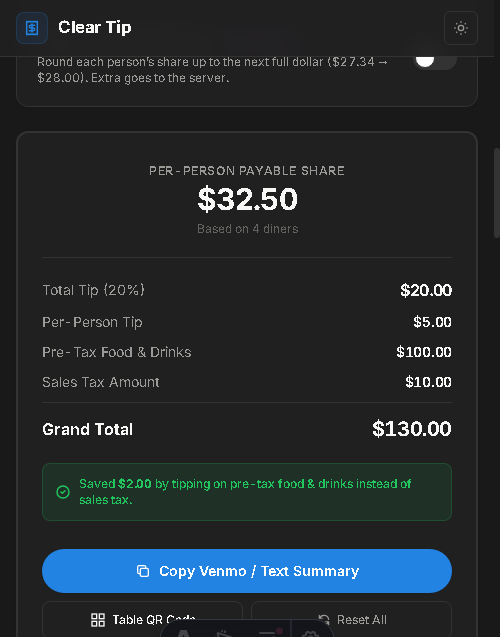
Clear Tip Calculator provides a transparent line-by-line breakdown on mobile, clearly separating base food subtotals, taxes, and service tips.
- Open Clear Tip Calculator on your mobile smartphone browser.
- Enter your check figures to view real-time per-person payable amounts.
- Check the pre-tax savings callout badge to verify that surcharges are handled fairly.
The Legal Difference: FLSA Protection vs. House Revenue
Navigating the footer of a restaurant receipt has become increasingly confusing over recent years. Surcharges labeled as "Kitchen Appreciation Fee", "Employee Wellness Charge", and "Hospitality Fee" have proliferated.
From a legal standpoint, the difference between a tip and a service charge is night and day:
Protected by Section 3(m) of the Fair Labor Standards Act. Must be retained 100% by non-exempt service staff (servers, bussers, food runners). Managers and owners cannot touch this money under federal criminal penalty.
Considered restaurant gross income. The restaurant management can distribute it to kitchen cooks, use it to pay healthcare stipends, or absorb it into general operational overhead and utility bills.
Because owners legally control service fees, diners cannot assume that writing a service fee replaces gratuity unless explicitly labeled as "Hospitality Included."
The Diner’s Rulebook: How Much to Tip When Fees Appear
When you encounter service charges on your check, use this practical guideline:
- Full Service Charge (18%–20%): Often termed "Hospitality Included" or "Fair Wage Surcharge." This replaces traditional tipping entirely. You do not need to add any tip unless you wish to leave a nominal cash token for exceptional service.
- Small Kitchen Surcharge (2%–5%): These funds typically subsidize back-of-house culinary wages. Your waiter does not receive this money. You should still tip your server 18% to 20% on the pre-tax food and drink subtotal.
- Credit Card Processing Surcharge (3%–4%): These fees cover merchant terminal costs. They do not benefit staff. Tip based on your actual food and beverage subtotal.
Consumer Protection and Junk Fee Legislation
Both federal authorities (FTC) and state attorneys general (such as California’s SB 478) have begun scrutinizing hidden restaurant surcharges. Under modern transparency standards, restaurants must clearly disclose any mandatory fee on the menu before you place your order.
If a restaurant fails to disclose a fee until the check lands on your table, you have the full legal right to request its immediate removal.
Frequently Asked Questions
Common questions and answers regarding service charge vs tip restaurant.