
Tip Pooling & Tip Sharing: How Restaurants Distribute Your Gratuity
Quick Answer
Tip pooling is an arrangement where servers contribute a percentage of their tips (or food sales) into a collective pool shared with support staff like bussers, food runners, and bartenders. Under federal law, managers and owners are strictly prohibited from participating in tip pools or keeping any portion of customer tips.
- ✓Traditional Tip Pooling: Shared exclusively among front-of-house staff (servers, bussers, runners, bartenders).
- ✓Non-Traditional Pools: If a restaurant pays all staff full minimum wage (no tip credit), back-of-house cooks and dishwashers may be included.
- ✓Managers and Supervisors: Banned by federal law from receiving any money from employee tip pools.
- ✓Mandatory Tip-Outs: Servers typically tip out 3% to 5% of their gross sales to support teammates.
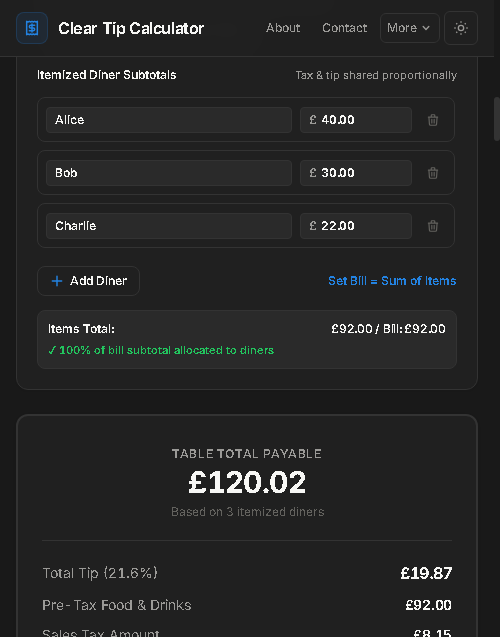
Clear Tip Calculator uses proportional distribution algorithms identical to restaurant tip pooling models, ensuring every participant pays their exact mathematical share.
- Understand that your tip supports an entire hospitality team including bussers and runners.
- Calculate proportional food, tax, and tip contributions for each diner.
- Leave a generous pre-tax gratuity knowing it rewards both front-of-house and support staff.
Tip Pooling vs. Tip-Out: What Is the Difference?
In American restaurants, your tip rarely goes solely to your primary waiter:
Servers keep their own tips, but must pay a fixed percentage of their total shift sales (usually 1% to 2% to bartenders, 1.5% to bussers, and 1% to food runners). If a table leaves 0% tip, the server literally loses money out of their own pocket paying out their team.
All gratuities collected during a shift are placed into a central fund and distributed mathematically based on points or total hours worked by each team member.
The Federal Prohibition on Manager Tip Deductions
Under the 2018 and 2021 Department of Labor amendments to the FLSA, employers, managers, and shift supervisors can never keep any portion of employee tips, regardless of whether a tip pool exists.
A manager can only keep tips if a customer hands it directly to them for service they personally and solely provided without the assistance of other employees (such as tending the bar alone on a Tuesday afternoon).
Can Cooks and Dishwashers Be Included in Tip Pools?
Under historical labor regulations, back-of-house staff (cooks, dishwashers) were legally excluded from tip pools. However, recent federal rule updates allow restaurants that pay full state minimum wage without taking a tip credit to establish non-traditional tip pools that include kitchen cooks and dishwashers.
This policy helps bridge the historic wage gap between dining room servers and culinary line cooks.
Point Systems & Hours Weighting in Modern Shift Pools
To distribute shared tip pools equitably across complex dining room shifts, many restaurants implement a mathematical point system. Rather than dividing tips evenly among everyone on the floor, team roles receive proportional point weights based on experience and responsibility:
- Lead Server: 10 points per hour worked
- Service Bartender: 8 points per hour worked
- Food Runner: 5 points per hour worked
- Busser / Barback: 4 points per hour worked
Each employee's hours are multiplied by their point weight to determine their share of the shift's total gratuity pool, guaranteeing transparent and fair compensation for all support contributors.
Frequently Asked Questions
Common questions and answers regarding how does tip pooling work restaurant laws.