
The Tipped Minimum Wage & Tip Credits Explained: Why US Tipping Exists
Quick Answer
The federal tipped minimum wage in the United States has been frozen at $2.13 per hour since 1991 under the Fair Labor Standards Act. Employers take a "tip credit" of up to $5.12 per hour, meaning customer gratuities legally make up the difference to reach the standard $7.25 minimum wage.
- ✓The federal cash wage for tipped employees is $2.13 per hour, unchanged for over 30 years.
- ✓Tip Credit: Employers pay $2.13 as long as customer tips equal at least $5.12 per hour to meet $7.25.
- ✓Seven states (including California, Washington, Oregon) have abolished the tip credit, requiring full state minimum wage before tips.
- ✓In states with a $2.13 wage, servers depend on customer tips for 75% to 85% of their total take-home pay.
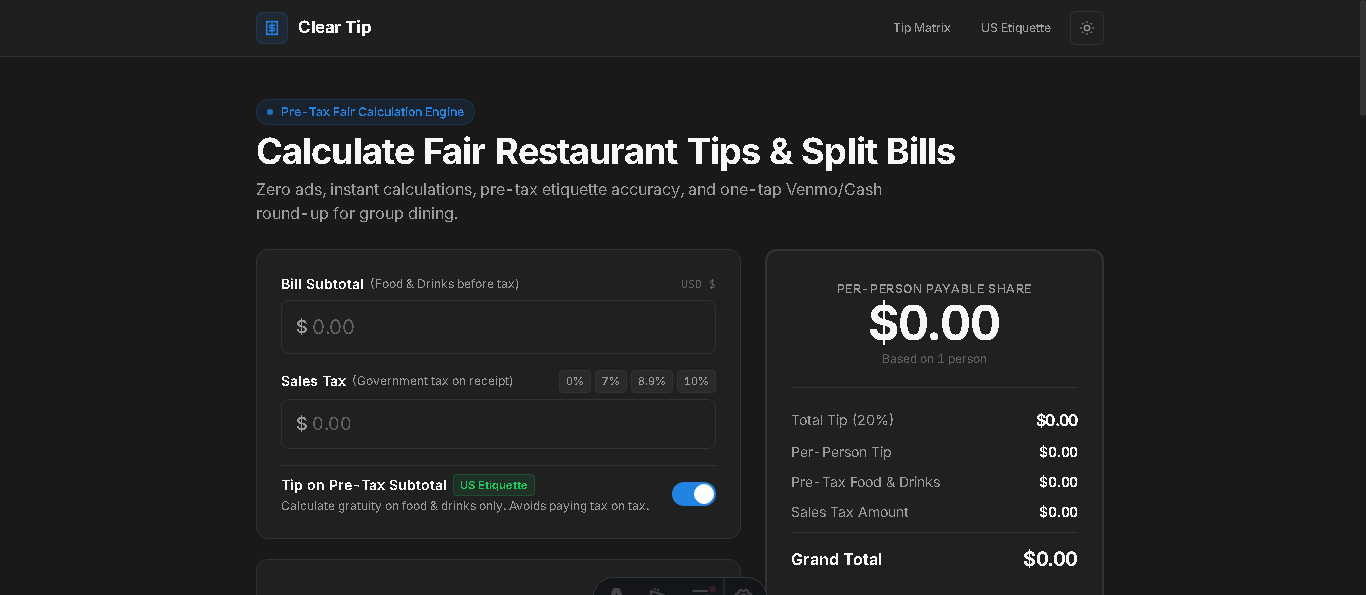
Clear Tip Calculator ensures diners provide fair, living gratuities to tipped service personnel while maintaining pre-tax mathematical accuracy.
- Understand that your server relies on customer gratuity for their primary income.
- Calculate a full 18% to 20% gratuity on the pre-tax food and drink subtotal.
- Ensure the service staff is rewarded equitably without paying unnecessary tax on tax.
How the Tip Credit Works in Practice
Under the Fair Labor Standards Act (FLSA), an employer can pay a direct cash wage of $2.13 per hour to employees who customarily receive more than $30 per month in tips. The employer claims a "tip credit" representing the difference between $2.13 and the federal minimum wage of $7.25 ($5.12/hr).
If a server’s combined tips plus $2.13 do not equal at least $7.25 per hour across their workweek, the restaurant is legally required to make up the difference. In practice, however, wage enforcement is difficult, making consistent customer tips essential.
The Two Americas: Tip Credit States vs. Full Wage States
Tipping expectations remain culturally consistent across the US, but server compensation varies dramatically by state:
- Full Minimum Wage States (No Tip Credit): California, Washington, Oregon, Nevada, Montana, Minnesota, and Alaska require restaurants to pay servers the full state minimum wage ($16.00–$20.00/hr) in addition to all customer tips.
- Sub-Minimum States: Over 15 states (including Texas, Georgia, North Carolina, and Pennsylvania) still permit the baseline $2.13 federal tipped wage.
Because cost of living is extraordinary in major cities, tipping 18% to 20% remains customary across all 50 states.
Legislation and the "One Fair Wage" Movement
Voters and lawmakers in jurisdictions like Washington, D.C. (Initiative 82) and Chicago have voted to phase out the sub-minimum tipped wage over multi-year periods. As restaurants transition to paying full minimum wages, many establishments are experimenting with higher menu prices or service charges.
Review our companion guide on service fees vs tips to understand how restaurant pricing models are shifting.
The 80/20 Rule: Side Work and Non-Tipped Duties
Under Department of Labor regulations, tipped workers cannot spend unlimited time performing non-tipped preparatory tasks while earning sub-minimum wages. The "80/20 Rule" mandates that if a server spends more than 20% of their working hours (or more than 30 continuous minutes) performing non-tipped side work—such as rolling silverware, slicing lemons, or scrubbing kitchen baseboards—the restaurant must pay full standard minimum wage for that time.
This protection prevents restaurant operators from using sub-minimum tipped labor to substitute for dedicated janitorial and culinary prep staff.
Frequently Asked Questions
Common questions and answers regarding tipped minimum wage 2.13 federal tip credit.